

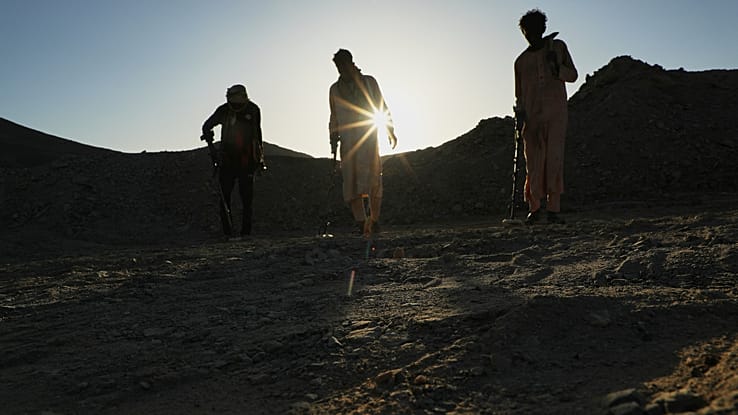
Survivors of a violent aerial attack near the Sudan-Egypt border have shared details of the strike that claimed 72 lives at Jabal al-Uqaydat, a vast mountain gold-mining district situated in contested territory claimed by both nations.
Human rights organizations have pointed to the Egyptian air force as the source of the strike.
Injured miner Ali Mohamed Hamza explained that they were preparing tea around 8:00 AM when an aircraft appeared overhead.
He noted that it circled above about three times while filming them before striking on the fourth pass.
Another wounded miner, Omar Mohie El Deen Abdullah, recalled that the initial strike caused an explosion right in the middle of the miners, estimated at nearly 300 people or more at the time.
He shared that by the grace of God he only suffered an injury to one of his fingers, but lost his brother, his cousin, and his maternal cousin in the attack.
The ongoing war in Sudan has shattered livelihoods, driving many citizens to informal gold mining as a critical economic lifeline and revenue source for warring factions. The border zone is also known as a major smuggling corridor.
Omar Abdullah, whose son Osman Omar died in the strike, explained that most local work is typically in agriculture, but the current farming season largely failed. As a result, everyone turned to mining to try and earn a living, especially with a sack of flour reaching 700,000 Sudanese pounds.
Without addressing the specific allegations directly, the Egyptian military stated on Monday that its forces and police were executing an operation targeting illegal gold mining near the border to impose full sovereignty within Egyptian territory and protect state resources.
The statement noted that warning flyers were dropped prior to targeting criminal elements, while urging the public not to be influenced by misleading rumours and foreign agendas that could harm bilateral relations.
Sudan’s de facto leader, Abdel Fattah al-Burhan, has ordered an investigation into the painful incident in the border area. According to the Transitional Sovereignty Council, he established a fact-finding committee composed of prosecutors, judicial officials, and security representatives to investigate the circumstances and submit a report.
His foreign affairs adviser, Amjad Farid, labeled the event an unjustified and unacceptable crime. Writing on X, he stated that while there are many ways to enforce the law and address border violations, the use of airstrikes against civilians cannot be one of them.
In a phone conversation with his Sudanese counterpart, Egyptian Foreign Minister Badr Abdelatty highlighted the mutual respect that binds the two brotherly nations, emphasizing respect for state sovereignty, territorial integrity, and border security.
This marks the second major strike reported at Jabal al-Uqaydat this year. In June, airstrikes reportedly carried out by Egypt killed 23 workers at the same informal mine.
During that instance, the Egyptian military did not claim direct responsibility, but confirmed conducting a large-scale operation against illegal mining within its borders.
