

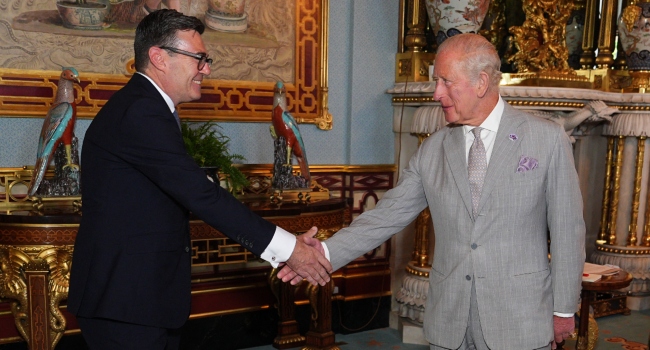
Andy Burnham officially assumed the role of British prime minister on Monday following a formal meeting with King Charles III at Buckingham Palace. The new leader is preparing to outline his plans for the nation after succeeding Keir Starmer.
Earlier on Monday morning, Starmer left Downing Street, using his final address to maintain that his two-year tenure had left Britain in a better position. Following Starmer’s formal resignation, the monarch met with Burnham to invite him to form a new government, an invitation Burnham accepted. At 56 years old, Burnham becomes the sixth prime minister to lead the country in the past decade.
In his parting speech outside the central London office, Starmer expressed confidence in his legacy, telling reporters, “I am confident that Britain is now stronger and fairer than it was two years ago.” He added, “I go with good grace, I go with a smile, and I go proud of everything that we have achieved.”
Burnham takes charge facing a mountain of urgent problems and a limited window to establish his authority. Speaking to The Times in an interview published late Sunday, he signaled a desire to break away from a decade of political instability.
“What we’ve been doing hasn’t been working. That’s the way I see it,” Burnham stated. “I am going to try and do things in a different way.”
According to his team, Burnham’s introductory speech will focus on priorities designed to rebuild public trust in the government and alleviate the financial pressure on citizens during the current cost-of-living crisis. Economic growth and shifting power to regional communities are also set to be central themes.
Burnham is also anticipated to name his senior cabinet members on Monday, with significant attention focused on who will succeed Rachel Reeves as finance minister.
The former Greater Manchester mayor, widely known as the “King of the North,” was brought back by the Labour Party after Starmer stepped down last month.
Lawmakers viewed Burnham as the party’s strongest option to counter the rising influence of Nigel Farage’s anti-immigration party, Reform UK.
The new prime minister inherits an array of pressing challenges, including a sluggish economy, high borrowing costs for the government, rising welfare expenses, and the ongoing arrival of irregular migrants in small boats, an issue that has driven support toward Reform UK.
Furthermore, global pressures such as volatile energy prices stemming from the US-Iran conflict and an unpredictable American presidency under Donald Trump present additional hurdles.
Elaborating on his economic strategy, Burnham told The Times he plans to implement a “different approach to public spending and to running the economy, more focused on early investment, early intervention, setting people up for success and much less paying for failure.” He also pledged “early moves to help” with the cost of living, noting that his time on the campaign trail highlighted the severe financial strain everyday people are experiencing.
Starmer originally brought Labour to power in July 2024 with a commanding election victory, ending 14 years of Conservative governance. However, he announced his resignation as both prime minister and Labour leader in late June after his administration was derailed by a series of scandals, errors, and policy reversals.
Though Burnham has a long political history, having served as an MP from 2001 to 2017 and holding ministerial roles under Tony Blair and Gordon Brown, he only returned to parliament four weeks ago. He now faces tight constraints, with low economic growth, substantial public debt, and strict fiscal regulations that require balancing state spending against tax income.
Since his time in parliament, Burnham has reshaped his public image into a relatable leader, blending a casual, approachable demeanor with effective social media communication. Nevertheless, he has just three years to yield results, as Reform UK currently leads in the polls ahead of the next general election scheduled for 2029.
Burnham recently told supporters on Friday that this transition represents the last chance for the Labour Party to get things right.
While critics previously faulted Starmer’s administration for being ill-prepared for governance in 2024, Burnham’s rapid rise to the leadership has triggered debates over how he plans to deliver on his agenda.
His initial policy move occurred on Saturday, when he terminated Starmer’s primary digital ID initiative, which was projected to cost £1.8 billion over three years. A spokesperson clarified that these funds and resources would be redirected to immediate priorities, such as mitigating the cost of living.
