

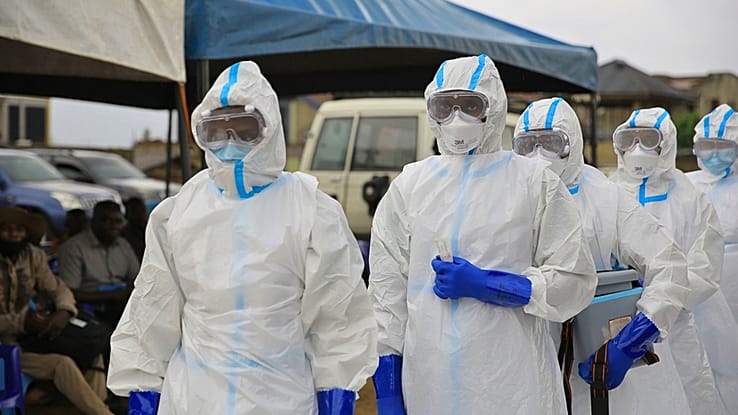
Health screening measures for international arrivals have been intensified across airports in Nigeria, where arriving passengers at Lagos airport have been queuing for routine body temperature checks.
The heightened response follows the national confirmation of its first case involving the Bundibugyo strain of the Ebola virus. The infected individual had traveled from Uganda, passing through Addis Ababa, Ethiopia, during a layover.
Returning from Italy via Addis Ababa, Nigerian traveler Patrick Akwongu expressed concern about the situation:
“Yeah, I’m scared because we have been hearing about the news the way people are dying in the Congo. So we don’t need such a case here in Nigeria because Nigeria is a crowded country. If such a thing happens here people will die like fowl, so we don’t want it.”
The Democratic Republic of Congo has been fighting its most severe Ebola outbreak since May, with additional cases recently confirmed in Kenya alongside this new case in Nigeria. Uganda was officially declared free of Ebola in August following 20 reported cases.
Another arriving passenger, Bezalel Mfashingabo, who traveled from Nairobi with a layover in Addis Ababa, offered a different perspective:
“I’m not worried at all but of course I’m taking precautions like being careful whom I am around with and I think also as a country (Kenya) having these cases recently they are also taking measures so the people who are infected they are quarantined so they are not very much you know exposed to the public, so there is no much panic there’s so much, no no panic no fear actually in Nairobi where I’m coming from.”
Health officials in Nigeria confirmed that the patient remains isolated and in stable condition. Contact tracing efforts are active, with 44 contacts identified so far as officials work to trace any additional potential exposures.
Concerns surfaced after reports indicated the patient was tested 13 days after initial symptoms appeared. Nevertheless, medical experts express optimism regarding the country’s containment capabilities, pointing to its successful effort in halting an outbreak in 2014.
Meanwhile, the World Health Organization alerted that the movement of the virus across regions from East to West Africa highlights a complex health crisis currently affecting the continent.
