

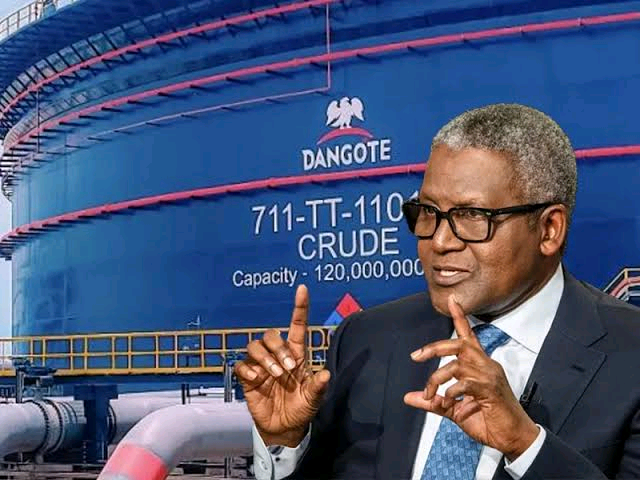
Notable businessman and Chief Executive of Dangote Industries Limited, Aliko Dangote, has warned that Africa’s continued dependence on imports is costing the continent its jobs and future, urging governments to protect local industries as a pathway to industrialisation.
“Allowing imports to displace local production means we are exporting our jobs out of the continent and importing poverty inside,” Dangote said.
He spoke during a wide-ranging interview with Financial Times Africa Editor, David Pilling, at the FT Africa Summit in London, where he unveiled a $50 billion investment plan for 2026 to 2030 and an aggressive pan-African petroleum distribution network.
Dangote disclosed that the Group just acquired a 25 per cent stake in Kenya’s petroleum products pipeline network with the support of the Kenyan government, and is developing distribution corridors and storage infrastructure in Djibouti, Ethiopia, Cameroon and Namibia.
“Just let me tell you, yesterday, with the support from the President of Kenya, we bought 25 per cent of the pipeline network for the distribution of petroleum products,” he said.
According to him, the new network will link the 650,000 barrels-per-day Dangote Petroleum Refinery in Lagos with markets across East, Central and Southern Africa, ending decades of fragmented supply and dependence on imported fuels.
He said Namibia will serve as a strategic hub for Southern Africa because of its proximity to Lagos.
He noted, “From our refinery to Namibia is just about four days of steaming”, saying that products landed in Namibia will be distributed to Botswana, South Africa, Zimbabwe and Zambia.
The Group is also building a major corridor linking Djibouti and Addis Ababa with tank farms and storage terminals, while a project in Cameroon is nearing completion.
The logistics expansion complements plans for a second refinery in Lamu, Kenya, with about 700,000 barrels per day capacity to serve East Africa’s growing demand. Dangote said Lamu was chosen for its deep-water access and that crude would be sourced from multiple markets.
He revealed the Kenya refinery decision was reached in four months, though vested interests attempted to stall it through court action.
Dangote argued that Africa cannot industrialise without protecting its industries, noting that even developed economies like America now protect theirs.
“If America is now saying, no, we are going to protect our industries, who are we in Africa not to protect our own industries?” he queried.
He said Africa’s biggest constraints remain power shortages, weak financial systems, and a lack of industrial policy, noting that 650 million Africans still lack electricity.
“The legacy we are trying to set up is: how do we industrialise our continent? The journey has started. But now we’re awake, and we will make it happen,” Dangote declared.
Dangote at GEF 2026
Alhaji Dangote, Africa’s wealthiest man, prominent businessman and industrialist, has played a significant role in advancing Africa’s industrial development through investments in petroleum refining, food production and other essential industries.
His business ventures have contributed to efforts to strengthen local production, expand industrial capacity and create economic opportunities across the continent. He has also consistently highlighted the importance of investment, entrepreneurship and business development in driving Africa’s economic growth.
Dangote is the Grand Patron of the Global Entrepreneurship Festival (GEF) 2026, scheduled to take place from November 6 to 8 at the JW Marriott Hotel in Cairo, Egypt.
The festival is recognised as an international platform for promoting entrepreneurship, innovation, investment and business development, bringing together stakeholders committed to advancing economic growth and enterprise development.
The 2026 edition will feature Ayanda Media Network as an official media partner and is expected to bring together more than 100 influential global leaders, renowned business icons, visionary entrepreneurs, investors and industry pioneers.
The three-day festival will feature 12 events and experiences designed to explore opportunities in entrepreneurship, investment, innovation, technology, leadership and global business.
Through discussions, networking and knowledge-sharing sessions, the festival aims to create opportunities for collaboration, strategic partnerships and the exchange of ideas capable of driving economic transformation.
