




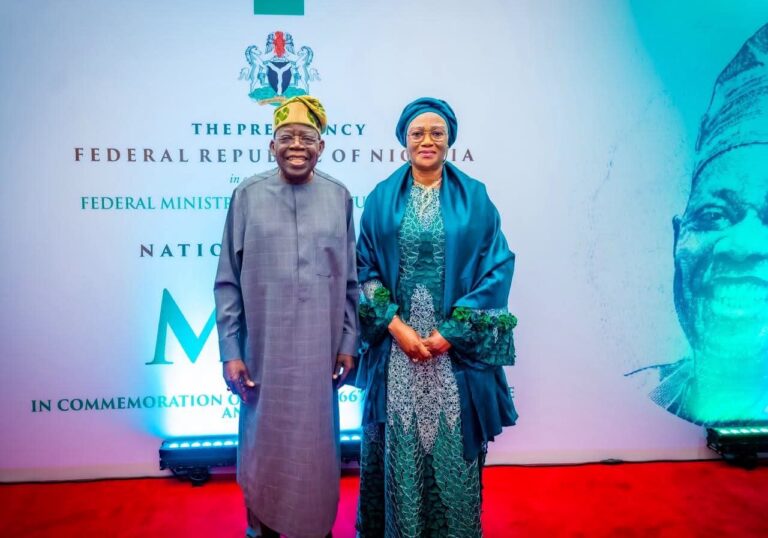
President Bola Ahmed Tinubu, accompanied by First Lady Oluremi Tinubu, attended the official national screening of MKO, a documentary detailing the life, political battles, and legacy of Chief Moshood Kashimawo Olawale Abiola alongside the historic June 12 pro-democracy movement.
Organised as part of events commemorating Nigeria’s 66th Independence Anniversary, the event took place at the Wole Soyinka Centre for Culture and Creative Arts in Abuja.
Directed by US-based filmmaker Ose Oyamendan, the project recounts the cancellation of the June 12, 1993 presidential contest—a critical turning point in the country’s democratic trajectory—and the persistent struggle by citizens and activists to bring back democratic governance.
The screening gathered various political figures and dignitaries, including Senate President Godswill Akpabio, Speaker of the House of Representatives Tajudeen Abbas, Kwara State Governor and Nigeria Governors’ Forum Chairman AbdulRahman AbdulRazaq, Lagos State Governor Babajide Sanwo-Olu, Ogun State Governor Dapo Abiodun, Plateau State Governor Caleb Mutfwang, and Chief of Staff to the President, Rt. Hon. Femi Gbajabiamila.
Other guests included Industry, Trade and Investment Minister Dr Jumoke Oduwole; Water Resources and Sanitation Minister Engr. Joseph Utsev; National Assembly members; former Ogun State Governor Chief Olusegun Osoba; among other prominent attendees.
Receiving the President and guests, the Minister of Art, Culture, Tourism and the Creative Economy, Hannatu Musa Musawa, highlighted the documentary as a vital initiative to preserve the history of the June 12 fight for future generations.
Speaking at the event, Special Adviser to the President on Information and Strategy, Bayo Onanuga, paid tribute to citizens who experienced persecution, imprisonment, exile, loss of life, and other hardships during the struggle for democracy.
Onanuga called for a minute’s silence to honor fallen activists, emphasizing that their contributions should never be forgotten. He noted that contemporary democratic freedoms were built on the bravery of citizens who resisted autocratic rule to protect the electoral decision made on June 12, 1993.
“We remember Chief Anthony Enahoro, Pa Adekunle Ajasin, Senator Abraham Adesanya, Chief Gani Fawehinmi, Dr Beko Ransome-Kuti, Pa Alfred Rewane, Chief Frank Kokori, Rear Admiral Ndubuisi Kanu, Commodore Dan Suleiman, Chima Ubani, Chief Bola Ige, Senator Cornelius Adebayo, Chief Ayo Adebanjo, Alhaji Balarabe Musa, Oba Sikiru Kayode Adetona, and all the leaders and members of the National Democratic Coalition, the Campaign for Democracy, the labour movement and other pro-democracy organisations,” he said.
Onanuga praised journalist James Bagauda Kaltho, alongside other media professionals and news outlets that reported on the June 12 movement despite facing detentions, abductions, and confiscations.
He extended appreciation to printers who distributed banned texts, legal professionals defending detained figures, student protesters, labor union members—especially NUPENG workers—who went on strike, academics offering intellectual backing, and diaspora groups organizing international pressure.
“We remember those who were imprisoned without trial, those imprisoned for being accessories to a coup d’etat, those driven into exile, those who lost their livelihoods, and those whose homes and businesses were attacked because they refused to surrender their democratic convictions,” Onanuga said.
He added that MKO serves as both a recognition of Abiola and a reminder of the shared sacrifices of citizens who fought to protect their voting rights.
“We remember the countless unnamed Nigerians who filled the streets, endured hardship and stood firm in defence of the mandate freely given on June 12, 1993. Many paid the supreme price. Many carried wounds that history may never fully record,” he said.
Onanuga observed that these sacrifices yielded lasting results, pointing out that Nigeria has maintained uninterrupted civilian rule since 1999, alongside the formal recognition of Abiola as the winner of the 1993 poll.
He commended the documentary team for documenting this period of national history for younger audiences.
“The democracy we enjoy today was built upon the courage and sacrifices of the people we have identified. We owe them more than remembrance. We owe them a duty to ensure that no authority ever again overturns the freely expressed will of Nigerians,” he said.
Musawa explained that the film traces the events around the 1993 election, its military annulment, Abiola’s 1994 arrest following his self-declaration as president, and his death while in custody in 1998.
“This documentary is in honour of the heroes of June 12, the men and women who gave their lives for the mandate of June 12, 1993 and for the democracy Nigeria enjoys today,” the minister said.
She stressed the importance of recording lesser-known accounts surrounding the June 12 election, often cited as one of the nation’s freest and fairest, to help younger generations understand the journey to current democratic institutions. She also urged citizens to defend democratic values and prevent future disruptions to the popular will.
The filmmaker, Oyamendan, praised President Tinubu for his steadfastness and democratic commitment, acknowledging his long-standing backing of the documentary project. He recalled interviewing Tinubu when he served as a senator in 1992 and thanked all parties involved in bringing the project to fruition.


