

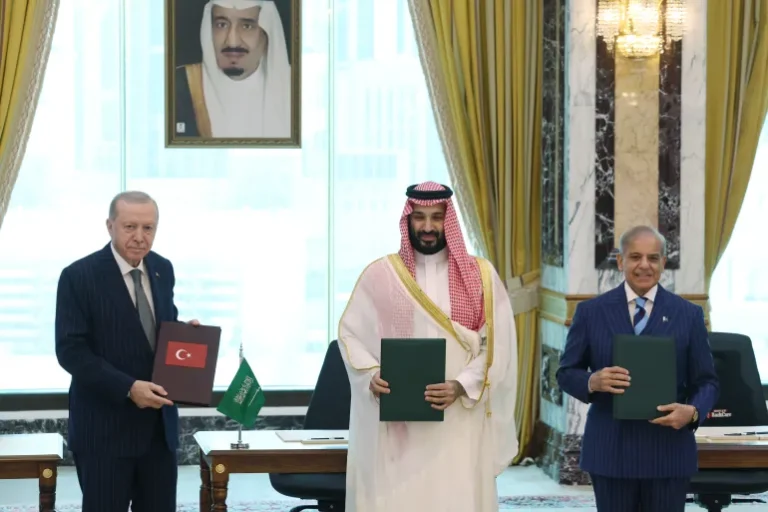
Saudi Arabia, Pakistan, and Turkiye have formalised a joint defence agreement to deepen security cooperation during a period of escalating military tensions across the Middle East.
According to a joint statement released on Friday by the official Saudi press agency and Pakistan’s Ministry of Foreign Affairs, the three nations signed the “Mecca Joint Defence Agreement.”
The signatories declared a “shared commitment to further strengthening their collective security and to promoting peace, security and stability in the region and beyond, in pursuit of a secure and prosperous future”.
Clarifying the scope of the treaty, Pakistan’s Foreign Ministry stated that an attack on any single member would be treated as an attack on all participants, noting the agreement was “intended to strengthen collective deterrence”.
The pact was sealed following the arrival of Pakistani Prime Minister Shehbaz Sharif and army chief Asim Munir in Saudi Arabia, where they performed the Umrah pilgrimage in Mecca. Turkish President Recep Tayyip Erdogan also arrived in Saudi Arabia on Friday to hold talks with Saudi Crown Prince Mohammed bin Salman.
Saudi Arabia has faced ongoing strikes from Iran, Yemeni Houthi forces, and Iraqi Shia armed groups following the February 28 attacks on Iran by the US and Israel. These hostilities have disrupted Saudi oil exports and economic development, raising doubts about the dependability of its traditional security alliance with the US. While Pakistan and Turkiye have largely avoided direct involvement, both nations seek to mitigate regional instabilities that threaten their broader economic and security interests.
The agreement comes after nearly a year of formal negotiations. Signing the document in Mecca carries notable symbolic weight, reinforcing long-standing bilateral defence relationships between the three nations. Historically, Pakistan has offered technical support and military training to Saudi forces, while Turkiye and Pakistan have engaged in joint naval and air force exchanges. Additionally, Riyadh signed its largest defense export contract with Ankara in 2023 to acquire Turkish drones.
Addressing concerns over the treaty, Saudi Arabia’s deputy minister for public diplomacy, Rayed Krimly, clarified that the pact poses no threat to neighboring countries. “The agreement does not represent any intention to build a military axis or a sectarian/religious bloc,” he posted on X, adding that it is “not linked to nuclear ambitions or an arms race, but rather to building sustainable, self-reliant capabilities”.
In a separate post on X, Turkish President Erdogan noted the pact was established “based on collective deterrence,” confirming Ankara would maintain “its principled stance toward resolving conflicts and crises through dialogue and diplomacy on the basis of respect for international law”.
Pakistani Prime Minister Sharif described the agreement as a “historic endeavour” designed to serve “the interests of our homelands and enhances the security and stability of our region”.
In contrast, Iranian lawmaker Ebrahim Rezaei expressed skepticism regarding the treaty’s ability to ensure regional peace. Posting on X, he stated: “Saudis must know that a paper agreement with Turkiye and Pakistan will not bring them security, just as years of one-sided nursing to the Americans did not bring them security.” Rezaei added, “Reform your policies so that you do not need to beg for security from others.”
Analyzing the development from Doha, Al Jazeera reporter Osama Bin Javaid observed that the deal aligns three prominent Muslim nations, forming a new regional security construct. “Pakistan brings with it, obviously, its nuclear arsenal, battle-hardened military, and munitions it has been supplying,” Bin Javaid noted. “Turkiye, with its advanced drone and munitions systems, is a NATO member, combined with the economic power of Saudi Arabia.”
Reporting from Ankara, Al Jazeera’s Resul Serdar Atas pointed out that defensive pacts often expand into wider economic collaboration. “It’s all about the trust now,” Serdar said. “There are expectations in Ankara that this will also boost economic ties with Riyadh and Islamabad.”
Abdulaziz Alghashian, a senior nonresident fellow at the Gulf International Forum, explained to Al Jazeera that the alliance combines “deterrence and diplomacy” to provide a framework for regional stability without directly targeting a specific country.
Retired Pakistani Major-General Zahid Mahmood echoed this assessment, highlighting that the primary goal remains “collective security.” He noted that by uniting, the three nations would “collectively approach the challenges the region is facing, and … help achieve stability and peace”.
